
MYOB – Modernisation
Future-Proofing MYOB
Unlocking Scalability through Business Transformation
Bridged the gap between technical architecture and customer experience by defining workstream boundaries for 5+ delivery squads, transforming a high-ambiguity system overhaul into a clear, de-risked roadmap for business transformation.
The Challenge: Untangling a Monolithic Legacy
For decades, MYOB relied on a custom-built, combined CRM and billing system. While it served the business in its early stages, it had become a monolithic bottleneck. As the company moved toward modern SaaS services, this legacy infrastructure was no longer able to support the speed of innovation required.
The problem
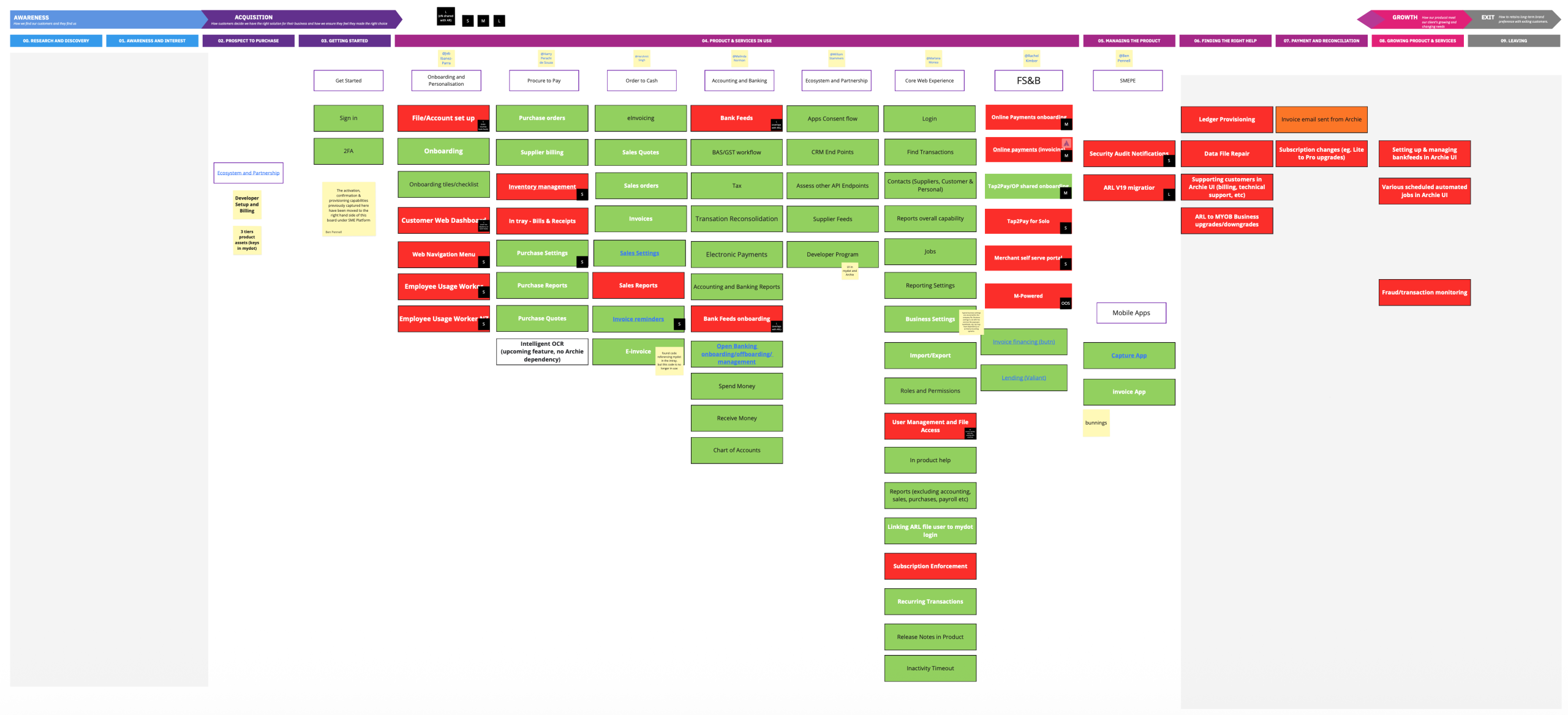
The existing system was a black box. A single change in a billing workflow could have unintended ripple effects across customer support, sales, and financial reporting. We needed to migrate our entire backend to a modern stack—Salesforce and GoTransverse—without disrupting the service for hundreds of thousands of existing customers.
The complexity
This was a little more than a simple “lift and shift”.
- High Ambiguity: No single source of truth existed for how all current workflows interacted.
- Cross-Functional Fragmentation: Five different streams of work were working on separate pieces of the puzzle, often with siloed information
- Zero Room for Error: We were working on the system that keeps our product alive, any unforeseen issues can turn into a catastrophe for customer trust and business revenue.
My Goal
My mission was to act as the connective tissue between technical architecture and the customer experience. I needed to identify every impacted workflow, determine the impact, design the “To-Be” service state, and ensure our Go-To-Market teams had a clear, friction-free narrative to share with our customers.
The Approach: Engineering Clarity from Chaos
Because the project touched every corner of the business, my approach had to be highly collaborative and analytical. I moved from broad discovery to deep synthesis, ensuring that the technical migration didn’t lose sight of the customer experience.
1. The Audit: Discovering the “Hidden” Workflows
I began by conducting deep-dive interviews and workshops with subject matter experts (SMEs) across Product, Sales, Support, and Finance.
- The Goal: To uncover the “workarounds” and edge cases that weren’t documented in the official help guides.
- The Result: I identified 40+ critical workflow impacts—points where the switch to Salesforce/GoTransverse would fundamentally change how an employee worked or how a customer received a bill.
2. Service Blueprinting: Visualizing the “To-Be” State
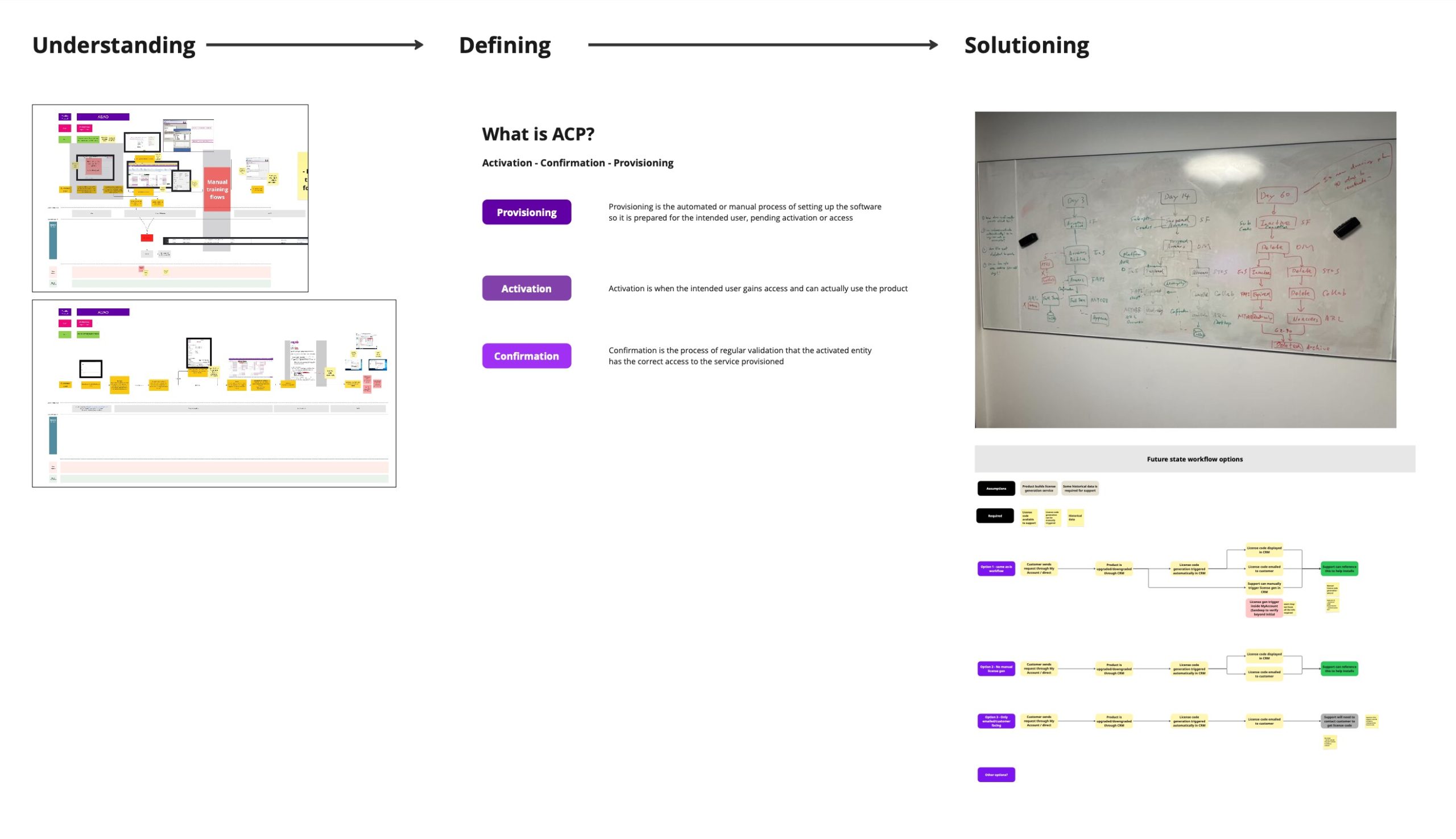
I synthesised these findings into comprehensive Service Blueprints. These acted as the “Source of Truth” for the entire project.
- I mapped the front-stage customer actions against the back-stage technical processes of Salesforce and GoTransverse.
- By visualising the “To-Be” state, I allowed stakeholders to see potential friction points before they were actually built.
3. Cross-Functional Facilitation & Workstream Definition
In a project of this scale, the “Who” and the “What” were constantly shifting. I stepped beyond traditional design tasks to help the organisation define its own structure for this transformation.
- Facilitating Technical Discovery: I led “discovery sprints” alongside engineering leads to uncover hidden technical dependencies. This wasn’t just about UI requirements; it was about understanding how data moved between the new systems and our legacy APIs, ensuring our design solutions were technically grounded from day one.
- Defining Workstream Scopes: Early on, the project suffered from overlapping responsibilities. I helped navigate and define the “Boundaries of Ownership” for different workstreams. By visualising the end-to-end service, I could point to exactly where one team’s work ended and another’s began, reducing duplicated effort and communication gaps.
- The Strategic Translator: I acted as the bridge between high-level Product Management goals and granular technical constraints. I ensured that while PMs focused on the “Why” and Engineers focused on the “How,” the entire group stayed aligned on the “What”—the actual experience being delivered to the customer.
Results & Business Impact
The success of this transformation wasn’t measured in pixels, but in the seamless continuity of our business operations and the readiness of our people to adopt a modern SaaS stack.
🛡️ Risk Mitigation
• Identified 40+ Workflow Gaps: Uncovered critical logic conflicts between legacy systems and the new SaaS stack early, preventing costly architectural rework and engineering debt.
• Protected Customer Trust: Safeguarded the billing experience for thousands of accounts, ensuring zero service disruptions during a high-stakes infrastructure shift.
⚙️ Operational Clarity
- Defined Workstream Boundaries: Resolved ambiguity between 5+ cross-functional squads by mapping technical touchpoints, establishing clear ownership, and reducing duplicated effort.
- Standardized the “Source of Truth”: My service blueprints became the primary reference for PMs and Architects to align technical constraints with user needs.
📢 GTM Readiness
- Internal Enablement: Provided the foundational maps used by Support and Sales to train staff on new system logic, ensuring day-one readiness across the organisation.
- Translated Technical Complexity: Partnered with GTM teams to turn backend architecture into clear customer narratives, successfully mitigating the support burden typically associated with core system changes.